
Multispecific
Antibody
Ask for advice
Integrated expertise to optimize multispecific antibody design
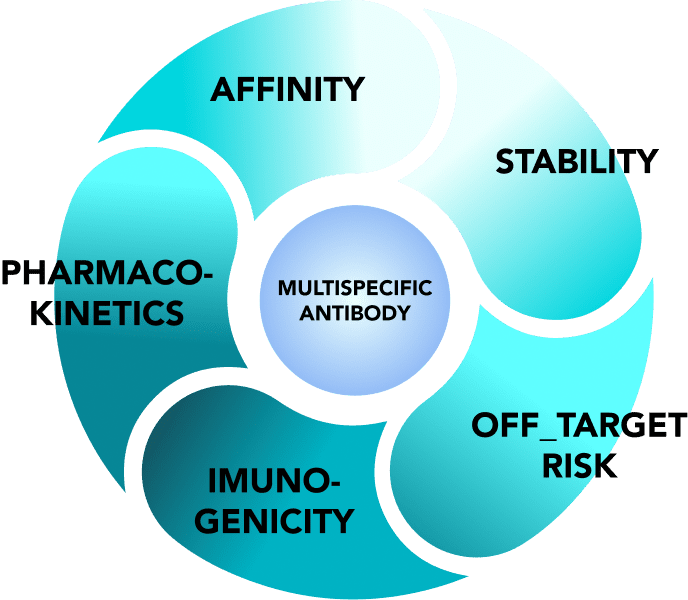
The development of multispecific antibodies, such as bispecific T-cell engagers, dual checkpoint inhibitors, or receptor-crosslinking antibodies, encounters several challenges: achieving high affinity for each target, maintaining stability of the designed molecule, and reducing the risk of off-target binding.
Relying on the proven expertise of MImAbs increases the chance of success therefore limiting the risk of delays and failures. MImAbs can help you move forward efficiently, with expertise in these formats to guide you through design, production, and validation accelerating development and increasing the chances of clinical success.
Rapid & Reliable Discovery
Identify new antibodies based on target binding, affinity, cross reactivity and functionality, all on Day1 using our Beacon® platform.
Tailored Immunization Strategies
Protein, peptide, cell, or RNA-based approaches adapted to your target complexity.
De-risked Development
Expert guidance and real-time functional screening ensure robust, validated leads.
Expert technical guidance
Access to specialized knowledge in antibody engineering and design of multispecific formats.
See the serviceReduced Development
Risk
Leverage MImAbs experience to avoid common pitfalls in molecular design and prepare for at-scale production.
Accelerated
Timelines
Faster progression from discovery to functional validation in continuous interactions with our partners.
See the serviceHigh-Quality outputs
Robust, well-characterized candidates ready for preclinical evaluation.
Partnering with MImAbs
can accelerate your progress.
From design to validation, our multispecific expertise ensures seamless guidance throughout your journey.
mAb Generation
- Immunization
- Multiplex function-first screening
- Sequencing
- Bioinformatics analysis
Ab Engineering
- Multispecific design
- Humanization
- Analysis of liabilities
Bioproduction
- Expression vectors with
engineered Fc regions - Transient expression
- Purification / Formulation
Biological Efficacy
- Selection of models
- PK & PD profiling
- Efficacy, Safety and Toxicity
Functionnal Characterization
- Affinity measurements
- Biochemical characterization
- Developability assessment
- Cytotoxicity assays
Flexible multispecific antibody formats tailored to your needs
Formats like Duobody, Knob-into-Hole and Arm Exchange, enabling efficient, stable, and tailored multispecific antibody designs.
Controlled chains exchange via mutations
In this method, two parental IgG4 monoclonal antibodies, each engineered with complementary point mutations in the hinge region, are first produced separately.
When combined under mild, precisely controlled redox conditions, their heavy chains partially dissociate and then re-associate, driving a controlled Fab-arm exchange between the two molecules.
This process yields highly pure bispecific IgGs, each composed of one Fab arm from antibody A and one Fab arm from antibody B, while preserving correct light-chain pairing and native IgG architecture.
- Produces fully native, IgG-like bispecific antibodies
- High purity and excellent structural integrity
- Robust and reproducible at manufacturing scale
- Clinically validated Genmab platform with multiple approved DuoBody-based therapeutics
Knob-into-Hole (KiH)
In a natural IgG, the two heavy chains interact via their CH3 domains, favoring homodimerization.
In the KiH approach, specific amino acid mutations are introduced:
- One heavy chain is engineered with a bulky residue (“knob”).
- The other is engineered with a smaller residue (“hole”).
This structural complementarity strongly favors heterodimer formation, ensuring the pairing of two different heavy chains.
- Efficient and reliable heavy-chain pairing
- Preserves natural IgG structure and Fc functions
- Compatible with large-scale production
Arm Exchange
In this method, two different monoclonal IgGs, each carrying subtle CH3 mutations, are produced separately,.
When mixed under controlled redox conditions, their heavy chains partially dissociate and then recombine in a precise manner.
This controlled Fab-arm exchange leads to the formation of bispecific IgGs, each containing one arm from antibody A and one arm from antibody B.
- Produces native IgG-like bispecifics
- Excellent stability and pharmacokinetics
- High reliability (works with many monoclonals)
- Clinically validated platform with approved drugs
Multispecific applications
Talk to one of our expert
Need expert support in ADC ?
Contact MimAbs to discuss your project, our team will support you in the scientific study and strategic development planning of your project.
Contact an expert